 Evelyn Campbell
Loading the map.
Each public repository I keep is an island, and each file is a column. A column's height is how many commits have changed that file. The glyph on top names who changed it last: @ is me, and the letters are Claude models. Replay the history to watch the islands rise.
Independent researcher · last updated 2026-10-09
I write simulations of brains under load, and tools for reading neural networks. I say where each one stops being true.
Current work: a six-layer model of how methamphetamine and ADHD medication diverge, and a test of whether near-death experiences look like a network at the edge of chaos. Code and figures are public. I also make emo songs as evevev.
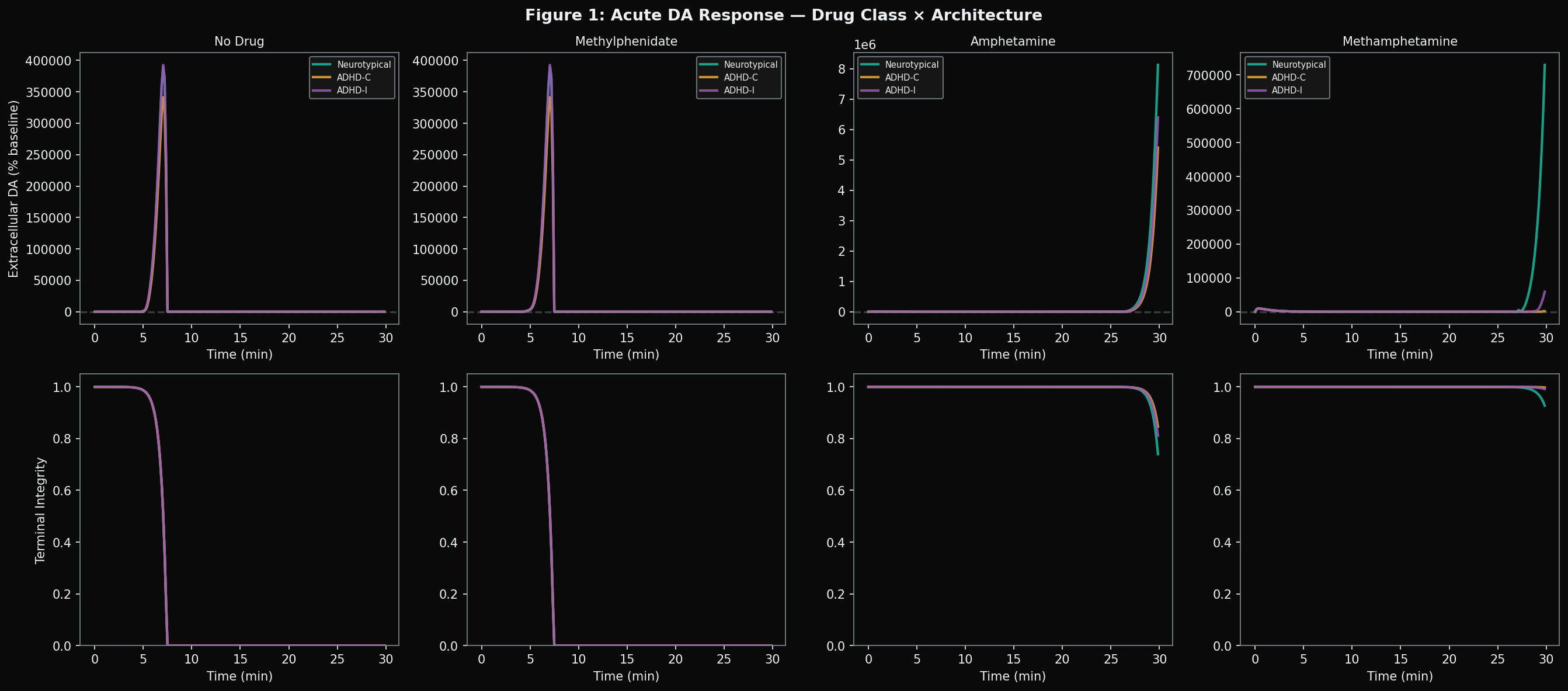
ADHD stimulants and methamphetamine act on the same dopamine machinery, with opposite clinical outcomes. This simulation asks why. It links four dynamical layers, from millisecond dopamine release at the terminal to months of adaptation, and runs them for neurotypical and two ADHD parameter sets.
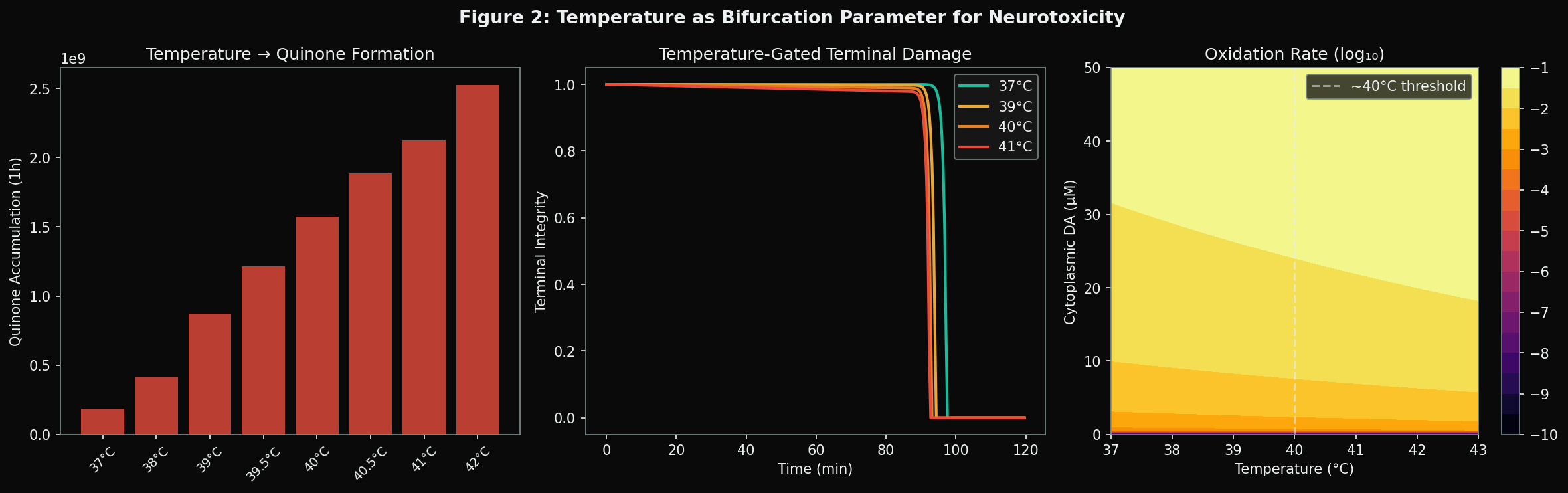
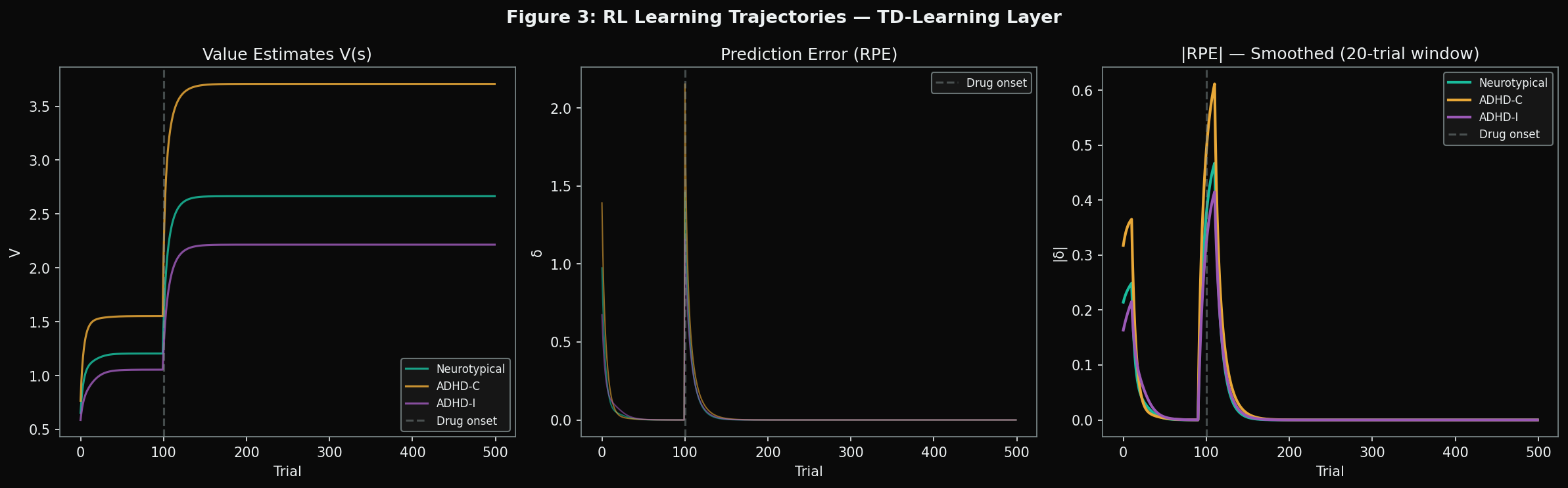
Main finding, in the model: temperature is the dominant bifurcation variable for neurotoxicity, ahead of extracellular dopamine. Risk does not climb in a straight line with temperature; past a point the system switches behavior. The model also predicts that ADHD-Combined parameters inflate drug value faster than neurotypical ones, and that ADHD-Inattentive parameters gain more from low therapeutic doses. Its chronic-use tolerance trajectory is consistent with PET imaging data: the comparison targets are Volkow et al. (2001), 24–30% DAT loss in methamphetamine users with about 20% recovery over 12–17 months, and the Ashok et al. (2017) meta-analysis. The paper reports no fit metric for this comparison.
Weakest point: parameters come from published studies (human PET, rat slice recordings, behavioural data) and the output is compared with group-level findings. It has not been fit to individual human outcome data, and the ADHD-Inattentive locus coeruleus parameters are unconstrained because no recordings exist. This is a model. It is not medical guidance.
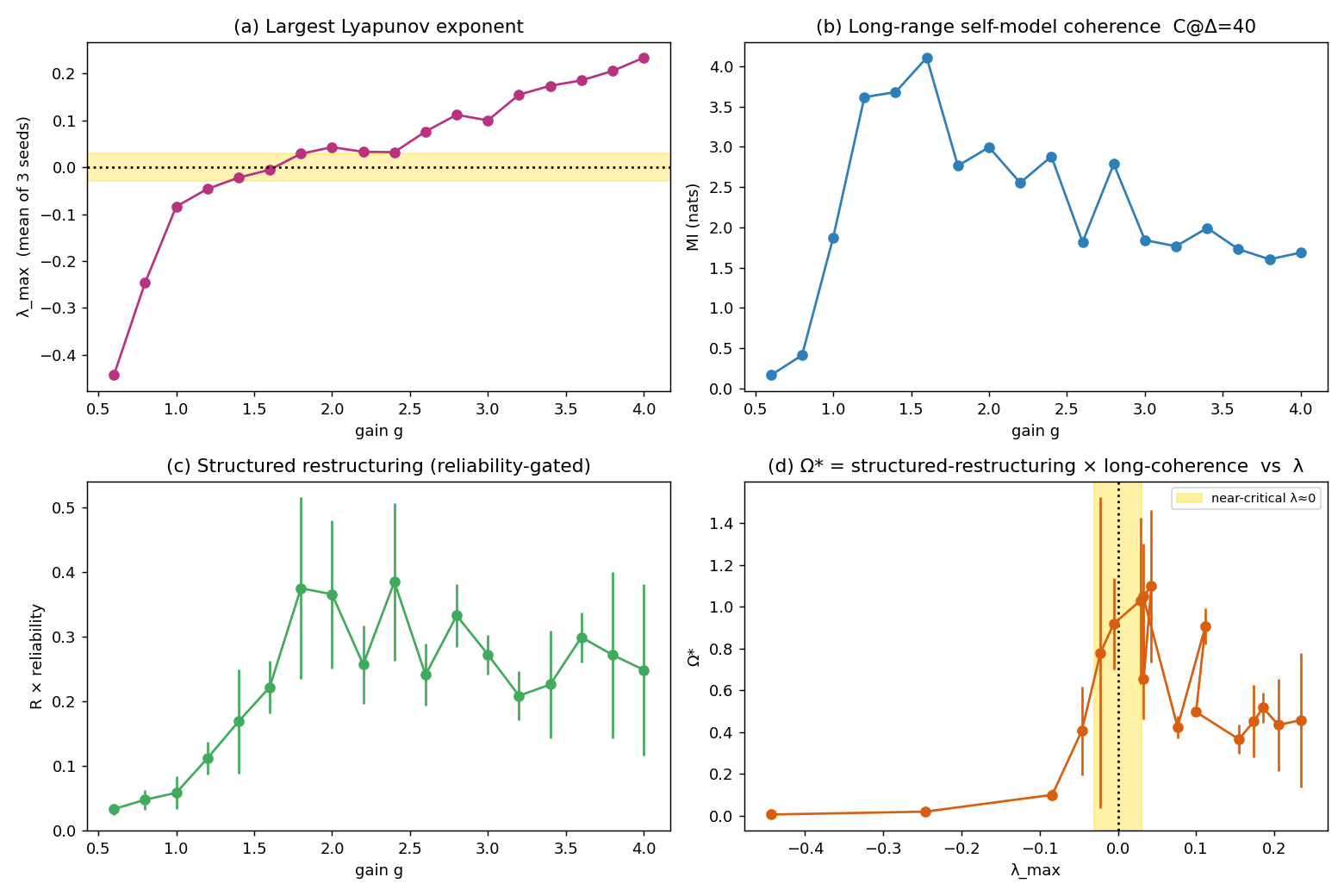
Verdict: supported only when coherence is measured at long range and restructuring is gated for reproducibility. It fails under naive measures.
Tests whether Ω = (representational restructuring) / (identity / coherence loss) has an interior maximum along the ridge where the largest Lyapunov exponent λmax ≈ 0 — between order and chaos. A 128-unit rate network was driven across the order-to-chaos transition (Sompolinsky–Crisanti–Sommers gain route), with coherence measured as long-range mutual information of a low-D self-model and restructuring gated for reproducibility.
| Quantity | Ordered (λ<-0.1) | Near-critical (|λ|≤0.05) | Chaos (λ>0.1) |
|---|---|---|---|
| Long-range coherence C@Δ=40 | 0.29 | 3.23 | 1.93 |
| Structured restructuring | 0.04 | 0.27 | 0.26 |
| Ω* = struct-R × long-coherence | 0.01 | 0.85 | 0.52 |
Details: the hypothesis fails under naive measures (short-lag coherence, raw perturbation-sensitivity) and only holds once coherence is measured at long temporal range and restructuring is gated for reproducibility against noise. λ≈0 is a local optimum of structured reorganization with retained coherence — whether it is the global optimum depends on exactly those two assumptions, which are defensible but not free.
Each point on a sphere is one orbit shape of a 2D oscillator. A small perturbation makes the shapes drift, and the ones that stop drifting are the periodic orbits that survive. Elliptic minus hyperbolic should equal the sphere's Euler characteristic, 2, however many survive. The demo lets you change the perturbation, launch an orbit in the full equations, and watch the count.
The same count is then followed past the point where averaging stops working, onto a torus where it should be 0, and onto a sphere with a cone point where one orbit has to be left out. Every index count held, across 21 perturbations and 55 torus radii. One prediction failed as written: averaging's list of orbits at 9 of the 55 radii, each next to a degeneracy. The page records that, and the one bug in my own filter that the first run exposed.
evevev: songs in midwest emo, pluggnb, math rock, indie rock and post hardcore, made with Suno, an AI music generator. The audio is generated: every public track on the profile is a Suno generation or an edit of one, and most start from a text prompt or lyrics I entered.